Explore the current biomarker landscape and review ovarian cancer information

In the US, ovarian cancer is one of the leading causes of cancer deaths among women and is characterized by a lack of validated screening tools, frequent late-stage diagnosis, and high rates of recurrence.1,2

In the US, ovarian cancer is one of the leading causes of cancer deaths among women and is characterized by a lack of validated screening tools, frequent late-stage diagnosis, and high rates of recurrence.1-2​

Prevalence
Ovarian cancer (OC) is often diagnosed at later stages, resulting in poor prognosis for patients.3​
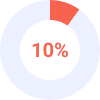
55%
diagnosed at late stages (cancer has metastasized)3​
31.4%
5-year relative survival at late stages3​*
5-year relative survival
at late stages3​*
*Relative to the general population.
Histology
Epithelial ovarian cancer (EOC) has 5 major histotypes exhibiting a large degree of heterogeneity.4 FRα expression is a prognostic biomarker that is more prevalent in patients with high-grade, serous histology.5,6
Epithelial Ovarian Cancer4
CCC
EC
MC
LGSC
HGSC
Clear cell carcinoma
Endometrioid carcinoma
Mucinous carcinoma
Low-grade serous carcinoma
High-grade serous carcinoma
CCC=clear cell carcinoma; EC=endometrioid carcinoma; EOC=epithelial ovarian cancer; FRα=folate receptor alpha; HGSC=high-grade serous carcinoma; LGSC=low-grade serous carcinoma; MC=mucinous carcinoma; OC=ovarian cancer.
Biomarkers
Analyzing biomarkers could help improve disease detection and evaluation of treatment responses.2,4
NCCN Clinical Practice Guidelines in Oncology (NCCN Guidelines®) for Ovarian Cancer/Fallopian Tube Cancer/Primary Peritoneal Cancer V.1.20257*
In the recurrent setting, tumor molecular analysis is recommended to include, as appropriate, tests to identify targeted therapeutics that have tumor-specific or tumor-agnostic benefit, including, but not limited to:7​
Genetic Alterations
BRCA1/2
BRAF
RET
NTRK
Protein Expression
HER2
FRα
Other Analyses
Homologous recombination deficiency (HRD) status
Microsatellite instability (MSI)
Mismatch repair (MMR)
Tumor mutational burden (TMB)
*Referenced with permission from the NCCN Clinical Practice Guidelines in Oncology (NCCN Guidelines®) for Ovarian Cancer/Fallopian Tube Cancer/Primary Peritoneal Cancer V.1.2025. © National Comprehensive Cancer Network, Inc. 2025. All rights reserved. Accessed March 25, 2025. To view the most recent and complete version of the guideline, go online to NCCN.org. NCCN makes no warranties of any kind whatsoever regarding their content, use or application and disclaims any responsibility for their application or use in any way.
BRAF=B-Raf; BRCA1/2=breast cancer gene 1/2; FRα=folate receptor alpha; HER2=human epidermal growth factor receptor 2; NTRK=neurotrophic tyrosine kinase receptor; RET=rearranged during transfection.
PROTEIN BIOMARKER EXPRESSION
FRα and HER2 are protein biomarkers that are expressed in EOCs, with differential expression across histotypes.2,5,6,8-10
Protein Biomarker
FRα
HER2
Expression in OC
≤90%2
~7–39%8
Prevalence Across Histotypes
Most prevalent in patients with HGSC5,6
Differs across histotypes and studies9,10
Expression Consistency in Select Studies
Retained in ~88% of recurrent tumors following chemotherapy5,11
Increased in ~58% of time-lagged biopsies and following OC treatment9*
Biomarker prevalence and expression consistency estimates are based on multiple sources, including small, single-center studies. Data can vary among studies and data sets because of detection methodologies, modalities, and reagents as well as patient sample sizes and/or demographics/characteristics. Some biomarkers may overlap.

*The treatment in this study contained both platinum-based chemotherapy and poly (ADP-ribose) polymerase inhibitors.
EOC=epithelial ovarian cancer; FRα=folate receptor alpha; HER2=human epidermal growth factor receptor 2; HGSC=high-grade serous carcinoma; OC=ovarian cancer.
Relevant Resources
TAP TO DOWNLOAD A PDF SUMMARY OF OVARIAN CANCER AND FRα INFORMATION
References
  1. Key Statistics for Ovarian Cancer. American Cancer Society. January 16, 2025. Accessed March 25, 2025. www.cancer.org/cancer/types/ovariancancer/about/key-statistics.html.
  2. Bax HJ, Chauhan J, Stavraka C, et al. Folate receptor alpha in ovarian cancer tissue and patient serum is associated with disease burden and treatment outcomes. Br J Cancer. 2023;128(2):342-353. doi:10.1038/s41416-022-02031-x.
  3. SEER Cancer Stat Facts: Ovarian Cancer. National Cancer Institute. Bethesda, MD. seer.cancer.gov/statfacts/html/ovary.html.
  4. López-Portugués C, Montes-Bayón M, Díez P. Biomarkers in ovarian cancer: Towards personalized medicine. Proteomes. 2024;12(1):8. doi:10.3390/proteomes12010008.
  5. Kalli KR, Oberg AL, Keeney GL, et al. Folate receptor alpha as a tumor target in epithelial ovarian cancer. Gynecol Oncol. 2008;108(3):619-626. doi:10.1016/j.ygyno.2007.11.020.
  6. Köbel M, Madore J, Ramus SJ, et al. Evidence for a time-dependent association between FOLR1 expression and survival from ovarian carcinoma: Implications for clinical testing. An Ovarian Tumour Tissue Analysis consortium study. Br J Cancer. 2014;111(12):2297-2307. doi:10.1038/bjc.2014.567.
  7. Referenced with permission from the NCCN Clinical Practice Guidelines in Oncology (NCCN Guidelines®) for Ovarian Cancer/Fallopian Tube Cancer/Primary Peritoneal Cancer V.1.2025. © National Comprehensive Cancer Network, Inc. 2025. All rights reserved. Accessed March 25, 2025. To view the most recent and complete version of the guideline, go online to NCCN.org. NCCN makes no warranties of any kind whatsoever regarding their content, use or application and disclaims any responsibility fort heir application or use in any way.
  1. Serrano-Olvera A, Dueñas-González A, Gallardo-Rincón D, Candelaria M, De la Garza-Salazar J. Prognostic, predictive and therapeutic implications of HER2 in invasive epithelial ovarian cancer. Cancer Treat Rev. 2006;32(3):180-190. doi:10.1016/j.ctrv.2006.01.001.
  2. Kim YN, Chung YS, Park E, Lee ST, Lee JY. Human epidermal growth factor receptor-2 expression and subsequent dynamic changes in patients with ovarian cancer. Sci Rep. 2024;14(1):7992. doi:10.1038/s41598-024-57515-y.
  3. Verri E, Guglielmini P, Puntoni M, et al. HER2/neu oncoprotein overexpression in epithelial ovarian cancer: Evaluation of its prevalence and prognostic significance. Clinical study. Oncology. 2005;68(2-3):154-161. doi:10.1159/000086958.
  4. Crane LMA, Arts HJG, van Oosten M, et al. The effect of chemotherapy on expression of folate receptor-alpha in ovarian cancer. Cell Oncol. 2011;35(1):9-18. doi:10.1007/s13402-011-0052-6.
DISCLAIMER
Biomarker prevalence and expression consistency estimates are based on multiple sources, including small, single-center studies. Data can vary among studies and data sets because of detection methodologies, modalities, and reagents as well as patient sample sizes and/or demographics/characteristics. Some biomarkers may overlap.

See More
See Less